
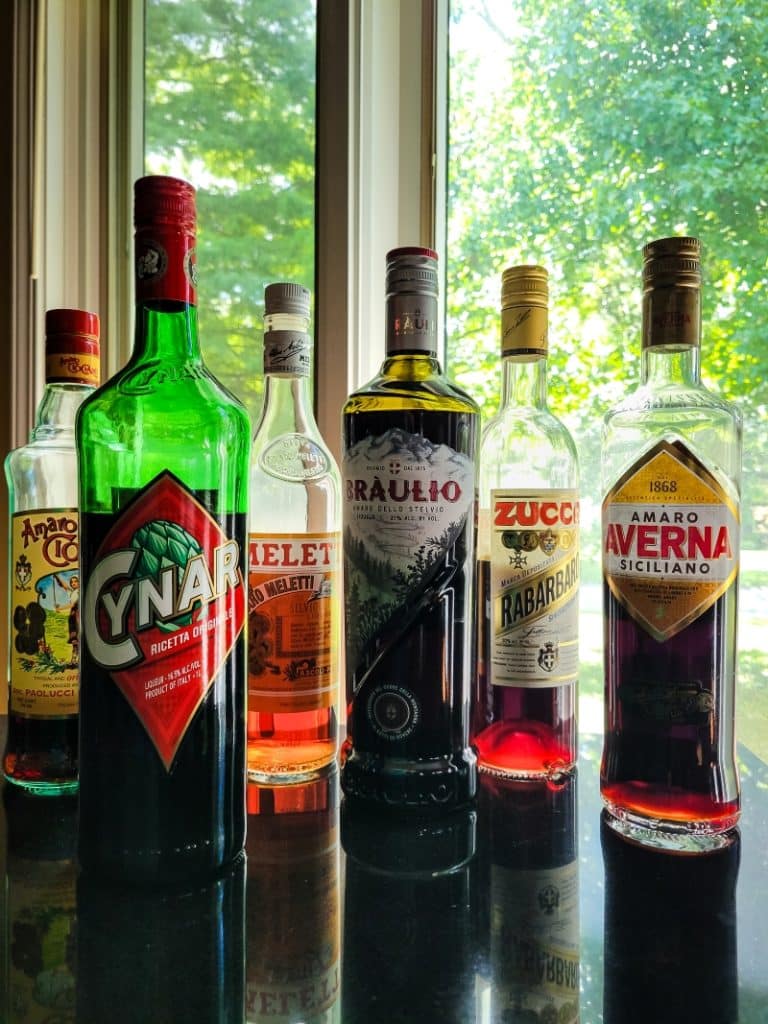
Whiskey people tend to meet amaro the way cats meet water: suspicious, then curious, finally obsessed and getting it into everything. Amaro isn’t here to hijack your bourbon or rye; it’s a flavor lever. Used well, it functions as bitters, sweetener, and depth—three levers that let you steer flavor without losing the whiskey.
This page expands on the Kentucky Bourbon Festival That’s Amari! class. You’ll get practical tasting tips, pairing logic that travels from your bar to mine, technique notes that keep bitterness clean, and fixes when a drink leans too sweet, too flat, or too muddy. Let’s mix it up —
What is amaro, in plain English?
“Amaro” is a family of bitter-sweet herbal liqueurs (typically 16–35% ABV) made by infusing alcohol with botanicals—roots, barks, peels, flowers, spices—then sweetening and blending to taste. These secretive liqueurs range from bright-citrus and floral to cola-spice to dark, savory, and vegetal. The bitterness isn’t a flaw; it’s structure. Think of it like oak maturation in whiskey: the scaffold that supports and elevates all the flavors in whiskey.
Why whiskey lovers should care
Amari are loud on the palate – with aggressive flavors of bitterness and botanicals, but in measured doses, they work magic when paired with bourbon and rye whiskey. Here’s why:
- They provide balance on demand. Amaro lets you push drinks brighter, deeper, or drier without piling on sugar.
- Amari add aromatics that matter. Botanicals can echo a whiskey’s grain, barrel, or yeast profile—so the cocktail tastes “of the whiskey,” not just “with whiskey.”
- They give less syrup, more flavor. When amaro supplies sweetness and complexity, you can reduce simple syrups and keep texture focused.
The three bottles we’re using (and what they do)
- Montenegro – Light, citrus-floral, honeyed. “Gateway amaro.” It lifts mid-proof bourbon, keeps sours lively and spritzes approachable, and adds a friendly, orangey finish.
- Ramazzotti – Cola, orange peel, baking spice. Think “bridge” between vermouth and amaro. It stands up to 100-proof bourbon and rye in stirred builds.
- Cynar – Savory, herbal, earthy (artichoke is on the label but flavor is broader and more nuanced). It sharpens rye spice, dries the finish, and turns a sweet-leaning drink serious.
Taste amari like you taste whiskey
Use a small tulip glass, or one of your many glencairns.
- Look: note color and viscosity (many amari carry body from sugar or caramel).
- Nose in passes: quick, soft breaths—start wide for citrus/floral, then go deeper for roots/spice/cocoa.
- Sip twice: first for bitterness location (front, mid, back), second to track sweetness, finish length and flavor complexity.
- Pairing check: take a tiny sip of your whiskey, then a tiny sip of amaro, then both together. You’re hunting echoes (shared notes) or complements (opposites that click).
Pro tip: If the bitterness of the sample is too aggressive, add a drop or two of 20% saline to the sample; it often rounds edges without extra sugar.
The pairing framework (brighten, deepen, sharpen)
- Brighten (lift + citrus): Montenegro with mid-proof bourbon or wheated styles. Great for sours, highballs, and Paper Plane-style builds.
- Deepen (cola + spice): Ramazzotti with 100-proof bourbon or rye. Black Manhattan/Boulevardier/Old Pal territory; richer mouthfeel without syrup creep.
- Sharpen (savory + robust): Cynar with rye. Brooklyn/Manhattan riffs that finish clean and read “grown-up,” not sweet.
Each amaro has it’s own flavor profile, bitterness and mouthfeel and each will combine differently with whiskey when used in cocktails. While the nose is a great guide to choose an amaro to match with a whiskey in a cocktail, you have four flavor levers/dials to use to adjust bitterness/sweetness.
- Citrus (acidity) – add to cut bitterness, balance sweetness or counteract astringency
- Sugar (actual or implied) – add to cut bitterness, balance sour or improve mouthfeel
- Dilution (texture/temperature) – add dilution to cut sweetness and increase bitterness; drop temperature to reduce bitterness and sweetness
- Proof (whiskey choice) – increase overall ABV to give whiskey the legs to stand up to the bitter elements; cut proof to allow the whiskey to meld and interact more with the flavors
Move one lever/dial at a time – tweaking until you find the cocktail’s sweet spot for your palate.
Techniques that keep bitterness clean
- Shaken vs stirred: Shaking increases aeration and dilution—bitterness reads brighter and shorter. Stirring keeps a longer, silkier, sometimes drier finish. Use shaken for citrus builds; stirred for Manhattan and spirit-forward cocktails.
- Dilution targets: Aim for 15–20% total dilution by volume for batched/served-cold drinks. Lower and the drink feels hot; higher and flavors can muddy.
- Ice matters: Big, clear cubes slow dilution for stirred/rocks service. Crushed or small cubes push brightness fast in sours—great for juleps, hot-weather drinks, less great for slow sips.
- Glass + temp: Thin glassware + colder service makes bitterness feel tighter and cleaner. Warmer service loosens aromatics but can emphasize medicinal notes—judge based on the amaro.
Batching and pre-dilution (the short version)
Batching with amaro is very similar to batching with any large format cocktails. The difference is that sometimes bitterness, left to marry in a batch for too long can explode. If you create the cocktail a few days in advance, you might need to adjust sweetness or bitterness just before serving.
- Start with your single-serve that’s dialed in.
- Multiply, then add 15–20% water to the total liquid volume for direct-from-fridge service. Reduce bitter elements by 25-30%.
- Chill at least 4 hours; stir before pouring.
- Always taste the batch right before serving. Add more bitters if needed just before serving.
- For events, pre-portion garnishes and label bottles with ABV and allergens.
How to make 20% saline, safely: Dissolve 20 g non-iodized salt (e.g., kosher) in 80 g filtered water for 100 g total. Store refrigerated. Dose 1–3 drops per cocktail.
Troubleshooting Amaro and Whiskey Cocktails
Just like any cocktail, knowing the audience who is drinking and how to manipulate the flavors is key. Here are some general tips to use when troubleshooting:
- Too sweet: Reduce syrups first, not the amaro. Or swap to a drier vermouth, add a barspoon of lemon juice (if it’s a sour cocktail), or 1–2 drops saline.
- Too bitter or hollow: Bump citrus by 0.25 oz, or add a barspoon of simple syrup. Consider a softer bourbon or a richer, more viscous vermouth.
- Muddy flavors: Shorten the ingredient list. Chill and stir longer. If using Cynar and sweet vermouth, try bianco/dry vermouth to clear the mid-palate.
- Flat finish: Raise whiskey proof, lower water a touch, or add a dash of aromatic bitters to lengthen.
Amari and Whiskey Buyer’s guide: start here
- One bottle per role: Montenegro (brighten), Ramazzotti (deepen), Cynar (sharpen).
- Price reality: Most sit in a friendly $25–$40 range.
- Storage: Shelf-stable. Keep open bottles cool and out of direct light; flavors hold for months.
- If you like…
- Wheated bourbon: start with Montenegro.
- High-rye bourbon or rye: try Ramazzotti, then Cynar.
- Cask-strength: split the modifier load (amaro + vermouth) rather than piling on sugar.
Recipes from the Kentucky Bourbon Festival Class
Here’s a quick reference to the recipes used at the Kentucky Bourbon Festival Class for our tasting samples.
Paper Bloom (riff on the Paper Plane)
- 1 ¼ oz Early Times BIB Bourbon
- ½ oz Aperol
- ¾ oz Amaro Montenegro
- ¾ oz lemon juice
- 2 drops 20% saline solution
- Garnish: dehydrated lemon slice
Directions: combine ingredients in a shaking tin and fill with ice. Shake for 8-10 seconds, then strain into a chilled couple and garnish.
Bananavardier (riff on the Boulevardier)
- 1.5 oz Old Forester 100
- ½ oz dolin sweet vermouth
- ¾ oz Ramazotti
- ½ oz banana liqueur
- 2 drops 20% saline
- Garnish – orange peel
Directions: Combine ingredients in a mixing glass fill with ice. Stir for 30 seconds, then strain into a chilled coupe and garnish with an orange peel or a candied pecan.
Bitter Brooklyn
- 2 oz Michter’s Single Barrel Rye or Barrel Strength Rye
- ½ oz Cynar Amaro
- ½ oz Dolin Sweet Vermouth
- ¼ oz Luxardo Marachino Liqueur
- 1 dash Scrappy’s orange bitters
- Garnish: luxardo cherry (or other non marachino cherry)
Directions: Combine ingredients in a mixing glass and fill with ice. Stir for 30 seconds, then strain into a chilled coupe and garnish with a luxardo cherry.
Quick FAQ
Does amaro replace bitters? Sometimes. It can play the bitters role while also supplying sweetness and body.
Will amaro make my drink sweeter? Depends on the bottle and ratio. Many amari feel sweet but finish dry—dose carefully.
Montenegro vs Nonino in a Paper Plane? Montenegro = brighter, more citrus-floral. Nonino = riper, orange-honeyed and slightly richer.
Can I use amaro instead of vermouth? In some stirred drinks, yes—expect a drier, more bitter profile. Adjust with a touch of syrup if needed.
What about soda? Splitting the modifier with soda or sparkling water is a clean way to reduce sweetness and lower ABV without losing character.
Glossary (fast and useful)
- Amaro: Bitter-sweet herbal liqueur; Italian origin, many regional styles.
- Gentian: Root that delivers clean, firm bitterness (common backbone).
- Cinchona/quinine: Bark-derived bittering; think tonic water
- Wormwood: Classic absinthe bitter; woodsy, lingering.
- Rhubarb root: Earthy, tangy bitterness (not the pie filling).
- Caramel coloring: Color adjustment; not a sweetness guarantee.
- ABV: Alcohol by volume; amari usually 16–35%.
- Saline: Salt solution (commonly 20%) used in drops to enhance definition.
